
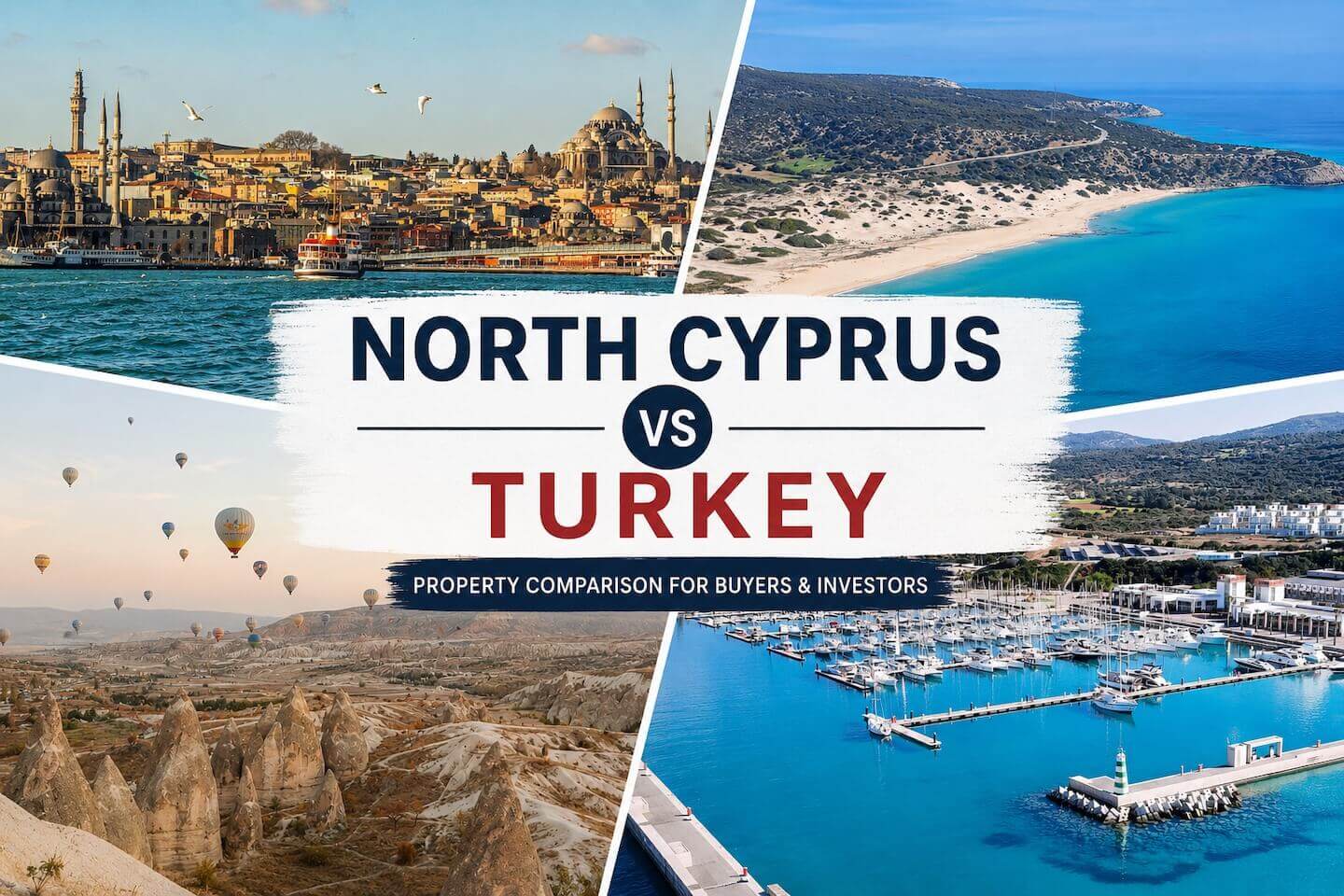
If you are considering buying property in the eastern Mediterranean, two markets deserve serious comparison: North Cyprus and Turkey. Both offer relatively affordable property compared with many Western European markets, attractive climates, established expatriate communities and strong tourism economies. But the investment proposition is quite different.
North Cyprus is generally more compelling for buyers seeking a lifestyle property, Mediterranean second home, retirement base or a focused property investment in a smaller market. Turkey offers a much larger and more diversified property market, stronger institutional infrastructure and significantly more choice across major cities and coastal destinations.
The right choice depends less on which country is “cheaper” and more on what you are trying to achieve: rental income, capital growth, lifestyle, residency, liquidity, diversification or long-term ownership.
Quick verdict: Choose North Cyprus if you value lifestyle, relatively accessible entry prices, a smaller English-speaking international property market and selected high-yield opportunities. Choose Turkey if you want a much larger market, greater liquidity, more established property infrastructure and access to major cities and international investment markets.
North Cyprus vs Turkey Property at a Glance
| Factor | North Cyprus | Turkey |
|---|---|---|
| Market size | Small, concentrated market | Very large, nationwide market |
| Entry price | Generally attractive, but varies substantially by area | Extremely broad range |
| Coastal lifestyle | Excellent | Excellent |
| Major international cities | Limited | Istanbul, Ankara, Izmir and others |
| Property choice | More limited | Vast |
| Rental market | Strong in selected locations | Strong but highly location-dependent |
| Rental yield | Attractive in selected areas | Varies significantly by city and property |
| Capital growth | Potentially strong in developing areas | Strong long-term potential, but highly cyclical |
| Foreign buyer infrastructure | Developing | More established |
| Ownership framework | Requires specialist due diligence | More standardised |
| Currency | British pound commonly used in property marketing | Turkish lira |
| Residency connection | Property ownership can support residence applications subject to conditions | Property ownership can support certain residence routes subject to current rules |
| Citizenship route | Different framework and should not be confused with Turkey | Property investment can form part of a citizenship route subject to current legislation |
| Liquidity | Smaller buyer pool | Much larger buyer and seller pool |
| Legal complexity | Higher due to Cyprus property history | Generally more straightforward |
| Best suited to | Lifestyle buyers and specialist investors | Diversified property investors and broader-market buyers |
1. The Biggest Difference: They Are Different Types of Property Markets
The most important mistake is to think of North Cyprus as simply a cheaper version of Turkey.
It is not.
Turkey is a large national property market containing everything from modest apartments in secondary cities to ultra-prime residences in Istanbul, beachfront villas in Bodrum and resort apartments in Antalya.
North Cyprus is a small island market concentrated around a relatively limited number of locations.
That difference affects almost everything:
- pricing;
- liquidity;
- development patterns;
- rental demand;
- resale;
- buyer demographics;
- infrastructure;
- risk;
- and potential capital growth.
Turkey gives investors scale and diversification.
North Cyprus gives investors concentration and exposure to a smaller emerging market.
For a buyer looking for a home in the Mediterranean, the smaller market can actually be an advantage. For an investor who wants to spread capital across multiple cities and asset classes, Turkey has the clear advantage.
2. Property Prices: Is North Cyprus Cheaper Than Turkey?
This is where comparisons can become misleading.
Property prices in Turkey and North Cyprus need to be compared carefully because neither market has a single meaningful price per square metre. Turkey is a huge and highly diverse market, and the prices relevant to an overseas buyer looking for a Mediterranean lifestyle are considerably higher than the national average. In Antalya, for example, current 2026 asking-price data puts Alanya at around TRY 60,000/m², Muratpasa at around TRY 57,000/m², Konyaalti at around TRY 80,000/m², and Kemer at around TRY 85,000/m². At a GBP/TRY exchange rate of roughly 63 in July 2026, that equates to approximately £950/m² in Alanya, £900/m² in Muratpasa, £1,270/m² in Konyaalti and £1,350/m² in Kemer. These are broad asking-price indicators and include different property ages, specifications and locations.
North Cyprus has a much smaller but equally diverse market. Broad listing data puts the overall median asking price at about £1,444/m², with Girne at approximately £1,956/m²; however, this national figure includes older, urban and lower-priced stock and is not a good benchmark for the quality coastal property normally considered by international buyers. In the principal coastal and resort markets, current asking prices are more realistically in the region of £1,700–£3,500+ per m², depending heavily on location, development quality, sea views, proximity to the coast, facilities and construction stage. Current market evidence places Iskele/Long Beach broadly around £1,700–£3,500+ per m², while Esentepe examples can be around £2,500/m², with premium frontline properties considerably higher.
The important conclusion is that North Cyprus should not be described simply as “cheaper than Turkey”. In some segments it is cheaper, particularly when compared with premium coastal locations such as Konyaalti, Kemer or prime Antalya. In other segments, a high-quality North Cyprus resort apartment can be priced at a similar level to, or even above, mainstream Turkish coastal property. The meaningful comparison is therefore property against property, location against location and quality against quality, rather than one national average against another.
The important point is that there is no single “North Cyprus price” and no single “Turkey price”.
A better comparison is by property type and location.
Indicative positioning
North Cyprus
- Lefkosa: lower-cost urban market
- Famagusta: university and local-demand market
- Iskele/Long Beach: large-scale coastal development market
- Esentepe: increasingly premium coastal and golf market
- Kyrenia/Girne: established premium lifestyle market
- Lapta and Alsancak: established coastal residential markets
- Kucuk Erenkoy and Tatlisu: lower-density coastal markets with investment potential
Turkey
- Istanbul: major international metropolitan market
- Antalya: major tourism and expatriate market
- Izmir: large coastal metropolitan market
- Mugla/Bodrum: premium lifestyle market
- Mersin: comparatively affordable Mediterranean market
- Ankara: major domestic urban market
- Numerous secondary cities: lower entry prices and different rental dynamics
Consequently, North Cyprus can be cheaper than prime Turkish coastal markets, but it is not automatically cheaper than Turkey as a whole.
3. North Cyprus vs Antalya
For many overseas buyers, the most useful comparison is not North Cyprus versus the whole of Turkey.
It is:
North Cyprus vs Antalya.
Both appeal to international buyers looking for:
- sunshine;
- beaches;
- modern apartments;
- golf;
- tourism;
- rental income;
- retirement;
- second homes;
- and an established expatriate population.
Antalya, however, operates at a much larger scale.
Emlakjet’s June 2026 figures put Antalya’s average residential price at approximately TRY 55,264/m2, with annual nominal growth of 26.9%.
North Cyprus, meanwhile, has a smaller market with significantly more variation between developments and locations.
Antalya advantages
- Larger population
- Larger domestic rental market
- Major international airport
- Much greater property choice
- Established tourism infrastructure
- Large resale market
- More conventional national property market
- Strong construction and development ecosystem
North Cyprus advantages
- Smaller, more manageable market
- Strong international lifestyle appeal
- British influence and widespread use of English
- Coastal properties available at different price points
- Attractive new-build opportunities
- Strong demand in selected resort locations
- Potentially higher yields in carefully selected developments
- Distinctive island lifestyle
The decision therefore comes down to whether you prefer market scale or market concentration.
4. Rental Yields: Which Market Is Better?
Rental yield is one of the areas where North Cyprus can be particularly interesting.
However, investors should be extremely careful with headline yield claims.
A development advertised with a projected 10% yield is not necessarily delivering a 10% net return.
You need to distinguish between:
Gross yield
and
Net yield.
Gross yield is normally:
Annual rental income / purchase price x 100
Net yield should account for:
- management fees;
- maintenance;
- furnishing;
- utilities where applicable;
- vacancy;
- platform commissions;
- insurance;
- taxes;
- repairs;
- sinking funds;
- and other ownership costs.
North Cyprus rental opportunities
Some North Cyprus locations can produce attractive rental returns, particularly where there is a combination of:
- tourism;
- university demand;
- expatriate demand;
- limited competing stock;
- good amenities;
- and strong short-term rental potential.
Areas such as Kyrenia, Zeytinlik, Iskele/Long Beach, Esentepe, Kucuk Erenkoy and selected university-linked locations can therefore be interesting.
But yield varies dramatically from one development to another.
A cheaper apartment in an oversupplied development can produce a worse investment than a more expensive apartment in a stronger location.
Turkey rental opportunities
Turkey also has strong rental markets, but the dynamics are different.
Antalya, Istanbul, Izmir and other major cities have much larger tenant populations.
Emlakjet’s June 2026 data indicates that Turkish residential markets have materially different amortisation periods between regions. The national average was around 13 years, while Antalya was around 16 years and Mugla around 18 years in the same dataset.
This illustrates an important principle:
The highest property price does not necessarily produce the highest rental yield.
5. Capital Growth: North Cyprus vs Turkey
Capital growth is more difficult to predict than rental income.
Turkey has experienced substantial nominal property-price increases in recent years, but inflation makes headline growth figures difficult to interpret.
For example, Emlakjet reported annual nominal residential price growth of 22.3% across Turkey in June 2026. However, when adjusted for inflation, real prices had declined across all of the five largest cities in its analysis.
This is an important lesson for investors:
A property price rising in local currency does not automatically mean that the investor has achieved real wealth creation.
North Cyprus has its own version of this issue because asking prices are frequently marketed in sterling while local costs and construction economics are influenced by other currencies.
Where North Cyprus may have an advantage
North Cyprus has several characteristics associated with potential long-term capital appreciation:
- limited land availability;
- growing tourism infrastructure;
- international buyer demand;
- expanding coastal developments;
- improving infrastructure;
- increasing quality of new developments;
- expanding golf and leisure infrastructure;
- and continued interest from overseas buyers.
Some areas remain considerably less developed than established Mediterranean markets.
That creates development-led growth potential.
But it also creates greater risk.
An investor buying into an emerging area is effectively betting that infrastructure, amenities, demand and resale liquidity will develop around the property.
6. The Importance of Location in North Cyprus
North Cyprus is small enough that buyers sometimes underestimate the differences between locations.
They should not.
Kyrenia / Girne
Best suited to buyers seeking:
- established lifestyle;
- restaurants and cafes;
- marina and old-town atmosphere;
- international community;
- rental demand;
- established resale market.
Kyrenia is generally the closest North Cyprus equivalent to a mature Mediterranean resort market.
The current North Cyprus property index places Girne at the top of its regional price rankings, at approximately £1,956/m2.
Esentepe
Best suited to:
- golf buyers;
- sea-view property buyers;
- second-home purchasers;
- lifestyle investors;
- buyers seeking newer developments.
Esentepe has become one of the strongest premium development corridors east of Kyrenia. Its attraction comes from the combination of coastline, mountain scenery, golf, resort developments and proximity to Kyrenia.
Iskele and Long Beach
Best suited to:
- investors;
- new-build buyers;
- buyers seeking modern apartments;
- rental-focused investors;
- buyers prepared to accept greater development and supply risk.
This is a much more development-driven market than central Kyrenia.
Lapta and Alsancak
These are established western coastal areas with a more traditional residential feel.
They can suit:
- retirees;
- permanent residents;
- second-home buyers;
- families;
- buyers seeking access to Kyrenia without living in the centre.
Lefkosa
Lefkosa is a different proposition.
It is primarily an urban market rather than a resort market.
Demand comes more from:
- local residents;
- professionals;
- students;
- businesses;
- and longer-term tenants.
7. Turkey Gives You Far More Choice
This is one area where Turkey wins decisively.
A buyer in Turkey can choose from:
- Istanbul apartments;
- Antalya resort apartments;
- Bodrum villas;
- Izmir coastal properties;
- Mersin developments;
- Ankara apartments;
- Bursa family housing;
- mountain properties;
- commercial property;
- land;
- student accommodation;
- luxury residences;
- and much more.
Turkey’s scale also creates opportunities for different investment strategies.
You can buy for:
capital growth, rental income, tourism, residency, citizenship, long-term occupation.
North Cyprus is considerably more specialised.
That is not necessarily a disadvantage. It simply means the buyer needs to be more precise.
8. Foreign Ownership
Both markets allow foreign nationals to acquire property, but the legal frameworks are different.
In Turkey, foreign natural persons from eligible countries can acquire real estate subject to legal restrictions. The Turkish Land Registry and Cadastre Directorate states that foreign individuals can acquire property up to a maximum of 30 hectares nationally, while foreign ownership in a district is subject to a 10% limit of the area where private ownership is permitted. Certain military and security zones are also excluded.
Turkey also has a highly developed official infrastructure for overseas buyers through the Your Key Türkiye system, which provides information about eligibility, procedures, legal requirements and property acquisition.
North Cyprus has its own rules governing foreign property acquisition and registration.
The crucial difference is not simply whether a foreigner is allowed to buy.
It is:
What exactly are you buying, and what is the legal history of the land?
9. The North Cyprus Title Deed Issue
This is perhaps the single most important difference for an overseas buyer.
North Cyprus has a complicated property history arising from the division of Cyprus in 1974.
The UK Government specifically warns buyers about disputed property in the north and advises extreme caution regarding properties where title documentation is not clear. It also notes that purchases involving disputed ownership can carry financial and legal implications beyond North Cyprus.
This does not mean that every property in North Cyprus is problematic.
It means that title due diligence is essential.
A professional buyer should understand:
- the title deed category;
- the registered owner;
- the property’s history;
- whether there are mortgages or encumbrances;
- planning permission;
- building permits;
- developer rights;
- contractual obligations;
- transfer requirements;
- and the implications of the underlying land title.
This is one area where North Cyprus requires a more specialised buying process than a straightforward overseas purchase in Turkey.
10. Turkey Has a More Standardised Registration System
Turkey also requires proper due diligence.
However, the transaction takes place within the Turkish national land registry system.
The Turkish government provides a dedicated official framework for foreign purchasers, including property registration procedures and documentation.
The official process includes requirements relating to:
- passport or identity;
- property title information;
- valuation in relevant circumstances;
- earthquake insurance;
- foreign identity number;
- banking documentation;
- and, where applicable, sworn translation.
For a buyer who values a highly standardised institutional process, Turkey has an advantage.
11. Residency
Property ownership can be relevant to residency in both jurisdictions, but the systems are not identical.
In North Cyprus, the authorities state that foreigners who possess immovable property may qualify for renewable residence permits subject to the applicable conditions. The rules distinguish between properties where title is already registered to the buyer and purchases made under contract, with additional conditions applying in the latter case.
This can make North Cyprus attractive to buyers who genuinely want to live on the island.
But buyers should not purchase property purely because somebody promises that ownership automatically gives them permanent residency.
Immigration rules can change.
The same principle applies to Turkey.
12. Citizenship: Turkey Has a Major Advantage
One of Turkey’s strongest differentiators is its established citizenship-by-investment framework.
Turkey has historically offered a route to citizenship through qualifying property investment, subject to the legislation and conditions in force at the time.
This is fundamentally different from buying a home simply to obtain residency.
Therefore, if citizenship is a primary investment objective, Turkey should normally be analysed before North Cyprus.
However, citizenship rules and minimum investment thresholds can change, so buyers should verify the current requirements directly before committing funds.
13. Currency Considerations
Currency is another major difference.
North Cyprus property is frequently marketed in British pounds, which makes the market particularly attractive and understandable to UK buyers.
Turkey is predominantly a Turkish lira market.
This creates both opportunities and risks.
A foreign investor buying in Turkey needs to consider:
- TRY exchange-rate movements;
- inflation;
- rental income in local currency;
- resale proceeds;
- and the currency in which the investor ultimately measures their wealth.
North Cyprus can appear simpler because many properties are priced in sterling.
But this should not be confused with being currency-risk-free.
Construction costs, local services, wages and other expenses can be influenced by multiple currencies.
14. Financing and Mortgages
Turkey has a larger and more developed banking sector, which generally provides greater financing choice.
North Cyprus also has financing options, including developer payment plans and local lending arrangements, but availability and terms can vary significantly.
For overseas buyers, developer finance can sometimes be attractive because it reduces the immediate capital requirement.
But it should be treated as a financial product rather than simply a sales incentive.
Before agreeing to a payment plan, examine:
- total purchase price;
- deposit;
- payment schedule;
- interest;
- currency;
- completion date;
- penalties;
- title transfer;
- and what happens if construction is delayed.
15. New Build: North Cyprus Has a Distinct Advantage
North Cyprus has a very large proportion of new-build and off-plan property relative to its size.
This creates opportunities that are less common in mature markets.
A buyer may be able to secure:
- early-stage pricing;
- staged payments;
- new construction;
- modern amenities;
- resort facilities;
- sea views;
- golf access;
- rental management;
- and potentially significant appreciation during the construction cycle.
But there is another side to the equation.
Off-plan property transfers development risk from the developer to the buyer.
The buyer must therefore investigate:
- developer track record;
- financial strength;
- previous completed projects;
- construction quality;
- delivery history;
- land ownership;
- planning permissions;
- contractor arrangements;
- service charges;
- resale restrictions;
- and the exact contractual terms.
A cheap off-plan apartment is not automatically a good investment.
16. Tourism and Short-Term Rentals
Both markets benefit from tourism, but at very different scales.
Turkey has an enormous international tourism industry.
Antalya, Istanbul, Mugla, Izmir and other destinations attract millions of visitors.
North Cyprus is much smaller but has a highly tourism-oriented economy, particularly around:
- Kyrenia;
- Famagusta;
- Iskele;
- Bafra;
- Esentepe;
- and the eastern coastline.
For investors, the smaller scale can sometimes work in their favour.
A well-positioned property with:
- sea views;
- quality facilities;
- swimming pool;
- parking;
- good internet;
- attractive furnishing;
- and access to restaurants and beaches
can compete effectively within its local market.
But short-term rental regulations and licensing requirements need to be checked before relying on holiday-let income.
17. Infrastructure
Turkey has a major advantage in infrastructure scale.
It has:
- large airports;
- extensive motorway networks;
- high-speed rail on selected routes;
- major hospitals;
- large universities;
- sophisticated shopping infrastructure;
- and enormous urban centres.
North Cyprus has considerably less infrastructure.
But that is changing in selected areas.
For lifestyle buyers, the question is not necessarily:
“Which has better infrastructure?”
It is:
“Does the infrastructure available in this particular location meet my needs?”
For someone retiring to Esentepe, the relevant questions may be:
- How long does it take to reach Kyrenia?
- How far is the nearest hospital?
- Is fibre internet available?
- Are supermarkets nearby?
- Is the road infrastructure adequate?
- How accessible is Ercan Airport?
- What happens during the winter?
That is much more useful than comparing national infrastructure statistics.
18. Airport Access
Turkey has a clear advantage in international connectivity.
Antalya Airport is a major international gateway.
Istanbul has two major international airports and enormous global connectivity.
North Cyprus relies primarily on Ercan International Airport for air access, with travel arrangements and routes influenced by the island’s political status.
For most lifestyle buyers, Ercan is perfectly practical.
But for someone who travels internationally every week, Turkey’s larger airport network is a significant advantage.
19. Lifestyle: North Cyprus Is Difficult to Beat
This is where North Cyprus becomes particularly compelling.
The island combines:
- Mediterranean climate;
- beaches;
- mountains;
- historic villages;
- golf;
- boating;
- restaurants;
- relatively relaxed pace of life;
- and a substantial international community.
For a British buyer looking for a Mediterranean lifestyle without the scale and density of many major Turkish resort cities, North Cyprus can be extremely attractive.
Turkey offers wonderful lifestyle locations too.
Bodrum, Antalya, Fethiye, Kas, Marmaris and the Aegean coast can provide exceptional quality of life.
But some Turkish resort areas have become considerably more developed and expensive.
North Cyprus still offers areas where the built environment feels relatively low-density.
20. Which Is Better for Retirees?
For retirement, the decision becomes much more personal.
North Cyprus may suit you if you want:
- a slower lifestyle;
- English widely spoken;
- an established expatriate community;
- relatively low-density coastal living;
- a house or apartment near the sea;
- golf;
- sunshine;
- and a smaller community.
Turkey may suit you if you want:
- major hospitals;
- extensive shopping;
- large cities;
- greater transport connectivity;
- more cultural variety;
- more domestic travel options;
- and a much larger choice of locations.
For retirement, North Cyprus often wins on lifestyle simplicity; Turkey wins on infrastructure and choice.
21. Which Is Better for Capital Growth?
There is no universal answer.
The strongest opportunities in either market tend to be highly location-specific.
North Cyprus capital-growth strategy
A sensible approach is to look for:
- improving infrastructure;
- limited competing land;
- high-quality development;
- strong views or location advantages;
- credible developers;
- established resale demand;
- improving amenities;
- realistic entry pricing.
This makes areas such as Esentepe, selected parts of the Kyrenia corridor and carefully chosen eastern coastal developments interesting.
Turkey capital-growth strategy
Turkey offers far more ways to pursue growth.
You can invest in:
- emerging Istanbul districts;
- Antalya;
- Izmir;
- Ankara;
- Mersin;
- developing transport corridors;
- regeneration areas;
- or premium coastal markets.
The opportunity is larger, but so is the research requirement.
22. Which Market Has Better Liquidity?
Turkey.
There is simply no contest in terms of market depth.
Turkey has:
- tens of millions of residential properties;
- a huge domestic population;
- large numbers of transactions;
- institutional lenders;
- professional estate agencies;
- developers;
- investors;
- and an enormous resale market.
North Cyprus has a much smaller pool of buyers.
This means that an excellent North Cyprus property can still be highly saleable, but a poorly chosen property may take considerably longer to resell.
That makes property selection particularly important.
23. Risk: North Cyprus vs Turkey
Neither market should be described as risk-free.
The risks are simply different.
North Cyprus risks
- title and property history;
- smaller resale market;
- development risk;
- oversupply in selected locations;
- developer quality;
- changing foreign-buyer regulations;
- political uncertainty;
- infrastructure gaps;
- dependence on international buyers.
Turkey risks
- currency volatility;
- inflation;
- interest rates;
- economic cycles;
- regulatory changes;
- regional differences;
- earthquake risk in relevant locations;
- construction quality;
- political and macroeconomic risk.
The important point is:
Risk should be assessed at property level, not simply at country level.
A carefully selected property in a strong North Cyprus location may be a better investment than a mediocre property in Turkey.
And the reverse can also be true.
24. North Cyprus vs Turkey: The Investor Profiles
Choose North Cyprus if you are:
A lifestyle buyer
You want somewhere to enjoy rather than simply an investment spreadsheet.
A retiree
You value climate, community, English-language services and a slower pace.
A second-home buyer
You want a Mediterranean property that you can use personally and potentially rent.
A specialist property investor
You are comfortable researching individual developments and accepting the characteristics of a smaller market.
A buyer looking for new build
You are interested in modern resort-style developments and staged payments.
Choose Turkey if you are:
A diversification-focused investor
You want access to multiple cities and property markets.
A high-liquidity investor
You want a much deeper resale market.
A citizenship-focused buyer
Turkey’s citizenship framework may be a significant consideration.
A metropolitan buyer
You want Istanbul, Ankara, Izmir or another major urban centre.
An investor seeking scale
You want a market with enormous domestic and international demand.
25. The Most Important Question: What Are You Actually Buying?
Country comparisons can only take you so far.
The real investment question is:
What specific property are you buying, in what location, at what price, with what expected rental income and what exit strategy?
Consider two hypothetical purchases:
Property A
A £180,000 apartment in a prestigious, established North Cyprus location with strong rental demand, good management, excellent amenities and limited competing stock.
Property B
A £150,000 apartment in a Turkish resort development with weak rental demand, high service charges and significant competing supply.
The Turkish property is cheaper.
But that does not make it the better investment.
The same principle applies in reverse.
A poorly located North Cyprus apartment bought at an inflated developer price may be inferior to a well-located Turkish property bought at a realistic market value.
26. A Better Way to Compare the Two Markets
Rather than asking:
“Is North Cyprus better than Turkey?”
score each property against the following criteria.
| Factor | Weight |
|---|---|
| Purchase price vs market value | 20% |
| Location quality | 15% |
| Rental demand | 15% |
| Resale liquidity | 10% |
| Capital-growth potential | 15% |
| Legal/title security | 10% |
| Developer quality | 5% |
| Running costs | 5% |
| Infrastructure | 5% |
This produces a much more useful investment decision than comparing national averages.
27. What About Value for Money?
North Cyprus can still offer compelling value, but the definition of “cheap” has changed.
The market is no longer simply a destination where you can buy a Mediterranean apartment for a fraction of European prices.
Quality developments in desirable coastal locations can command substantial prices.
At the same time, Turkey also contains enormous variation.
A buyer can still find relatively affordable properties in Turkey, while premium destinations such as Istanbul, Bodrum and parts of the Mediterranean coast can be extremely expensive.
The conclusion is therefore:
Neither country is universally cheaper.
The value question must be answered by location, property type, quality and price per square metre.
28. North Cyprus vs Turkey Property: Our Verdict
For most overseas buyers, there is no single winner.
The two markets serve different purposes.
North Cyprus wins for:
- Mediterranean lifestyle;
- smaller-market exposure;
- English-speaking environment;
- selected high-yield opportunities;
- new-build resort property;
- golf and coastal living;
- retirement;
- second homes;
- buyers who want a more intimate market.
Turkey wins for:
- market scale;
- liquidity;
- property choice;
- infrastructure;
- major-city investment;
- international connectivity;
- institutional market depth;
- diversification;
- and citizenship opportunities.
For pure investment
Turkey has the stronger market infrastructure.
For lifestyle plus investment
North Cyprus can be exceptionally attractive.
For retirement
North Cyprus is often the more appealing lifestyle proposition.
For diversification
Turkey wins.
For a new-build Mediterranean property
North Cyprus deserves serious consideration.
For maximum liquidity
Turkey wins.
Final Thoughts
The biggest mistake an overseas property buyer can make is choosing a country before choosing an investment strategy.
North Cyprus and Turkey are not competing versions of the same market.
Turkey is a vast, diversified national property economy. North Cyprus is a much smaller, specialist Mediterranean market where location, development quality, title structure and exit strategy can have an unusually large impact on the outcome.
If your priority is scale, liquidity, infrastructure and diversification, Turkey deserves serious consideration.
If your priority is lifestyle, coastal living, retirement, second-home ownership and carefully selected property investment, North Cyprus may offer the better fit.
For either market, however, the same rule applies:
Buy the right property in the right location at the right price – not simply the cheapest property in the cheapest country.
And in North Cyprus in particular, legal/title due diligence and developer due diligence should come before the sales pitch.
Frequently Asked Questions
Is property cheaper in North Cyprus or Turkey?
There is no universal answer. Turkey has an enormous range of property prices, from relatively affordable secondary cities to very expensive Istanbul and premium coastal locations. North Cyprus also varies significantly between Lefkosa, Famagusta, Iskele, Kyrenia, Esentepe and other areas.
Is North Cyprus a good place to invest in property?
It can be, particularly for buyers who understand the market and select the right location, development and property. The smaller market creates opportunities but also means that due diligence and resale considerations are especially important.
Is Turkey better for property investment?
Turkey has major advantages in market size, liquidity, infrastructure and diversification. But a large market does not automatically make every property a good investment. Location and purchase price remain critical.
Which has better rental yields, North Cyprus or Turkey?
Both can produce attractive rental returns, but yields vary dramatically by location and property type. North Cyprus can offer attractive yields in selected areas, while Turkey has deeper rental markets in cities such as Istanbul and Antalya. Always calculate net rather than advertised gross yield.
Can foreigners buy property in North Cyprus?
Foreigners can purchase property in North Cyprus subject to the applicable rules and permissions. The exact title, property history and acquisition procedure should be checked with an appropriately qualified independent lawyer before purchase.
Can foreigners buy property in Turkey?
Yes, eligible foreign nationals can purchase property in Turkey subject to statutory restrictions and location-specific rules. Turkey’s official Land Registry and Cadastre Directorate provides dedicated guidance for foreign buyers.
Which is better for retirement: North Cyprus or Turkey?
North Cyprus is often better suited to buyers prioritising a relaxed Mediterranean lifestyle, international community and coastal living. Turkey can be better for people who prioritise major hospitals, transport, shopping, cultural facilities and access to large cities.
Which is better for capital growth?
Neither can be guaranteed to outperform the other. Turkey provides a much larger range of growth markets, while North Cyprus offers exposure to a smaller market with selected areas undergoing substantial development. The specific property matters more than the country headline.
Should I buy in North Cyprus or Turkey?
Start with your objective. Decide whether you want a home, retirement property, rental investment, capital-growth investment, holiday home or citizenship-related investment. Then compare specific locations and properties rather than comparing countries alone.
A Note on Market Data
Property markets in both North Cyprus and Turkey are highly heterogeneous. Asking prices, transaction prices and developer launch prices can differ considerably. North Cyprus has particularly limited official transaction-level market data, so current listing-based indices should be treated as directional rather than definitive evidence of completed sales. Turkey has considerably more extensive national property-market data.
For that reason, a serious purchase decision should combine market statistics with actual comparable properties, independent valuation, title/deed checks, developer due diligence and realistic rental evidence.
Market information in this article reflects the latest available sources at the time of publication and should not be treated as financial, legal or tax advice.
Disclaimer:
All prices, costs, and figures mentioned in this article are approximate and for general informational purposes only. They may vary over time. Readers are advised to verify current rates, legal requirements, and financial details with relevant authorities, legal advisors, or service providers before making any decisions related to property purchase or relocation in North Cyprus.



Join The Discussion