

The most consistently profitable property investors rarely identify the best opportunity at peak visibility. They act earlier — when the infrastructure is being planned rather than completed, when the marina is a concept rather than a construction site, and when international buyers are still discovering a region rather than competing for the last available plots. This is the discipline that separates long-term wealth creation from short-term excitement, and it is precisely the discipline that North Cyprus now rewards.
Over the past decade, the island has shifted from a niche destination for adventurous buyers into a recognised investment market drawing serious international attention. Values have risen. Developments have grown in scale and quality. Airport connectivity has improved. The lifestyle proposition — Mediterranean climate, affordable cost of living, seafront access, and relatively low property taxation — has attracted a widening pool of foreign buyers, from UK retirees and Scandinavian second-home purchasers to Middle Eastern investors and European digital nomads seeking a productive base with genuine quality of life.
Yet for all the momentum, North Cyprus is not a uniform market. Capital growth in North Cyprus is a regional story, and understanding its nuances is fundamental to making an intelligent investment decision. Some areas have already matured. Others are mid-cycle. A handful are still at the stage where patient investors with a longer horizon may achieve the most significant appreciation.
This article analyses each of the primary regions — Kyrenia, Iskele, Esentepe, Bafra, Famagusta, and the western corridor — through the lens of long-term capital appreciation. It is designed for overseas buyers, investors, retirees, and lifestyle purchasers who want to understand where the next cycle of growth may emerge, and how to position themselves intelligently within it.
Understanding Capital Growth in Property Investment
Capital appreciation — the increase in a property’s market value over time — is distinct from rental yield, and the two are frequently conflated by first-time overseas buyers. Rental yield measures the income a property generates relative to its purchase price. Capital growth measures what happens to the purchase price itself. Both matter, but in different ways, at different stages of the investment cycle.
In emerging markets, the most significant returns tend to be generated through appreciation rather than yield. This is because prices are still being established, international demand is still growing, and infrastructure is still catching up with supply. Buyers who enter at this stage — before the region is fully understood by the broader market — absorb the upside as awareness, demand, and amenity all increase simultaneously.
Infrastructure is perhaps the single most powerful driver of residential property values. A new coastal road transforms access. A marina brings premium lifestyle appeal and a new category of buyer. A university creates persistent rental demand. An international hotel brand signals confidence to global buyers. These forces do not operate instantaneously — they compound over years — which is precisely why early-stage investors benefit disproportionately from them.
Foreign demand is equally important in a market like North Cyprus, where international buyers can represent the majority of transactions in certain coastal regions. When a new nationality begins entering the market — or when an existing buyer group increases its participation — prices adjust to reflect that demand. The scarcity of genuinely beachfront or sea-view land provides a structural floor beneath those prices over the long term. Once the coastline is developed, it cannot be replicated.
Timing matters in a way that is often underestimated. Buyers who enter too early, in areas without an infrastructure roadmap or genuine lifestyle drivers, may wait considerably longer than anticipated for appreciation to materialise. Buyers who enter too late — after the major appreciation has already occurred — pay full price for a mature market’s stability rather than an emerging market’s upside. The regions analysed below each sit at different points on this curve.
Why North Cyprus Is Attracting Growth-Focused Investors
North Cyprus has been compared, with increasing frequency and some justification, to earlier-stage versions of Southern European markets that are now significantly more expensive. The Algarve, the Côte d’Azur, Puglia, and the Turkish Riviera all experienced periods of rapid international interest — and corresponding price appreciation — as foreign buyers discovered their combination of climate, lifestyle, and relative affordability. North Cyprus occupies a similar position today, but earlier in that cycle.
The island sits at the intersection of three lifestyle trends that are reshaping where affluent international buyers choose to live, retire, or invest. The first is climate-led relocation: Northern European buyers, particularly from the UK, Scandinavia, and Germany, are increasingly prioritising warmer climates, lower living costs, and outdoor quality of life over proximity to major cities. The second is remote-work flexibility: a growing cohort of professionals, freed from office constraints, is choosing to base themselves in Mediterranean environments without sacrificing earning power. The third is retirement lifestyle migration: as Baby Boomer wealth transfers to a generation more willing to live internationally, the appeal of a financially favourable, climate-friendly, English-accessible jurisdiction like North Cyprus grows considerably.
On a purely comparative basis, the price differential between North Cyprus and its Mediterranean peers is striking. Properties commanding views and specifications comparable to listings in Southern Portugal, the Greek islands, or coastal Spain can be acquired in North Cyprus at a fraction of the price. This differential is not simply a reflection of political complexity or perceived risk — it is increasingly a representation of where the market sits in its maturity cycle, and therefore where the greatest percentage upside potential may reside.
Infrastructure investment across the island has accelerated. New arterial roads are improving journey times and opening up previously peripheral coastal land. Tourism projections and government policy are actively encouraging resort development, with Bafra as the most prominent example. Marina discussions, though in various stages, continue to generate significant interest from international developers. When any combination of these forces arrives in a given region, prices typically respond.
Kyrenia – Mature Market, Premium Stability
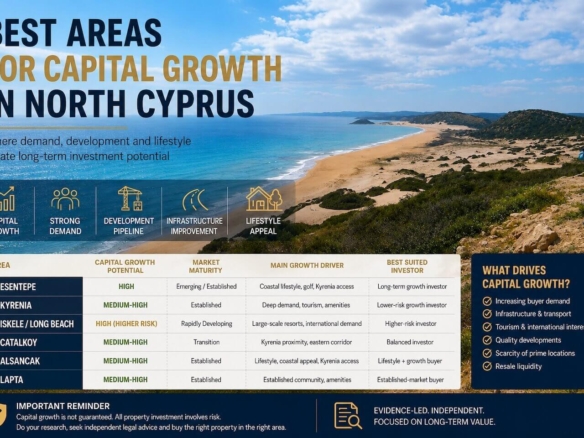
Kyrenia — known locally as Girne — is the most established property market in North Cyprus, and it occupies a category all of its own. For buyers seeking prestige, lifestyle infrastructure, and long-term demand resilience, it remains the benchmark. For buyers seeking the highest percentage appreciation over the next decade, it is likely not the primary opportunity.
What Kyrenia offers is something different and genuinely valuable: a mature, internationally recognised address with a depth of lifestyle infrastructure that other regions are still building toward. The old harbour, the castle, the mountain backdrop, and the concentration of international restaurants, private healthcare, English-language schools, and established expat communities create a demand base that does not simply evaporate in a downturn. Buyers from across Europe, the Middle East, and beyond understand the Kyrenia brand, and that familiarity commands a price premium.
The region’s sub-markets each have a distinct character. Central Kyrenia and the old town carry the highest premiums, with boutique restorations and sea-view apartments attracting affluent buyers who prioritise location above all. Bellapais — perched above the town with dramatic valley and sea views — remains one of the most desirable addresses on the island, with genuine scarcity in prime positions. Çatalköy and Ozanköy offer villa living within easy reach of the town, with strong expat communities and a more suburban character. Alsancak and Lapta, stretching west along the coast, provide more accessible price points with a blend of established developments and newer boutique projects.
The challenge for investors in Kyrenia is that the easy appreciation has, to a significant extent, already occurred. Prime land is limited, new development faces constraints, and the market already prices in the region’s desirability. Growth will continue — demand shows no sign of abating — but the profile is one of wealth preservation and stable, moderate appreciation rather than transformational upside. For buyers whose priority is lifestyle quality and long-term security, Kyrenia remains the natural first conversation.
Iskele and Long Beach – The Island’s Most Watched Growth Story
If Kyrenia represents North Cyprus at its most established, Iskele — and the Long Beach coastline in particular — represents the island at its most dynamic. Over the past five years, this region has attracted more international developer investment, more overseas buyer attention, and more first-time market entrants than anywhere else in North Cyprus. The scale of construction has been dramatic. The question for serious investors is not whether growth has occurred, but whether meaningful upside remains.
The case for Iskele begins with fundamentals. Long Beach is genuinely one of the finest stretches of coastline in the Eastern Mediterranean: a broad, gently curving bay with warm, clear water and a natural appeal that requires no marketing augmentation. The beach itself is a scarce asset. Beachfront development is finite, and as the coastline fills with resort-style complexes offering pools, fitness facilities, restaurants, and concierge services, the premium over a generic inland apartment compounds.
Entry prices in Iskele have historically been meaningfully lower than Kyrenia, and in a market where percentage appreciation is driven partly by the gap between current prices and mature-market comparables, that differential creates structural upside. Buyers who acquired beachfront or front-row apartments in Iskele in the early stages of the development cycle have seen significant value increases. The question for buyers entering today is whether that cycle still has runway, or whether the region is approaching maturity.
The honest answer is nuanced. Iskele is not uniformly priced, and project quality varies considerably. The best-positioned developments — those with genuine beachfront access, credible developers, quality construction, and strong owner communities — are likely to continue appreciating as the region’s international profile grows and rental demand matures. More peripheral developments, positioned on the fringes of the growth zone with less compelling specifications, carry greater risk, particularly if supply continues to expand ahead of demand.
Boğaz, to the north of Long Beach, offers a quieter, more village-orientated character with waterfront restaurants and a fishing harbour. It attracts buyers seeking a more authentic North Cyprus experience, and property prices here have benefited from the broader Iskele momentum without the resort-development density of Long Beach. For buyers who want coastal appreciation with a lower-key lifestyle, Boğaz deserves consideration alongside the headline Long Beach numbers.
For Iskele, the investment thesis remains compelling — but project selection is no longer optional. The era of buying anything in the region and expecting appreciation has passed. The next cycle will reward quality, location, and developer credibility above broad-market momentum.
Esentepe – The Luxury Lifestyle Corridor
East of Kyrenia, the coastal road climbs into the hills and descends toward Esentepe — a region that has, relatively quietly, established itself as one of the most compelling premium-growth markets in North Cyprus. It lacks the volume and visibility of Iskele, and it is less immediately recognisable than Kyrenia, but for a particular type of buyer — one seeking boutique luxury, dramatic scenery, and long-term appreciation in an uncrowded market — Esentepe may represent the most interesting investment story currently unfolding on the island.
The region is anchored by a golf course offering challenging play with extraordinary mountain and sea views, and the landscape around it lends itself naturally to low-density villa and boutique apartment development. Properties here are typically positioned higher, with panoramic vistas across the Mediterranean rather than the beach-level perspectives of Long Beach. The aesthetic appeal is markedly different — and for a growing segment of international buyers, more desirable.
Esentepe has attracted a buyer profile that tends toward semi-retirement, digital nomads, and discerning lifestyle investors rather than the holiday-let and resort-apartment buyers who dominate Iskele. These buyers tend to spend more time in their properties, care more about long-term build quality and community, and are less sensitive to short-term rental yields. This demographic shift matters for capital growth: buyers who intend to use and inhabit a property tend to drive values more sustainably than pure investment demand, which can retreat when yields compress.
The scarcity dynamic here is pronounced. Genuine seafront and sea-view land in Esentepe is limited, and the topography — dramatic cliffs and hillsides rather than broad flat coastline — means that each well-positioned plot is genuinely unique. As boutique developers arrive with higher-quality specifications, the premium associated with an Esentepe address is likely to grow. Discussions around potential marina infrastructure in the broader Kyrenia-to-Esentepe corridor, should they progress, would constitute a significant value catalyst for the region.
The appreciation trajectory in Esentepe is expected to be steadier and more sustained than in mass-market regions — but potentially more durable. This is a market where quality of project and quality of location compound over time, rather than a market driven by speculative momentum. For patient buyers with a seven-to-ten-year horizon, it is difficult to identify a more strategically interesting position.
Bafra – Resort-Led Transformation and Longer-Term Upside
South of Iskele and stretching toward the Karpaz Peninsula, the Bafra coastline has become the focal point of the most ambitious tourism-led investment in North Cyprus. Government policy has actively designated this zone as a priority development area for hospitality and resort infrastructure, and several large-scale casino resort complexes have been built or are under development along its beachfront.
For property investors, Bafra’s transformation presents a specific type of opportunity: one that is driven by institutional capital, government backing, and international hospitality brands rather than organic lifestyle migration. This distinction matters for how the opportunity should be evaluated. Bafra is not yet a residential community in the way that Kyrenia or Iskele is — it is a resort zone in active formation, and the capital growth story depends heavily on whether that formation continues to attract the international visitors and buyers necessary to sustain it.
The upside case for Bafra is genuine. A successful, internationally connected resort zone on a genuinely beautiful stretch of coastline, backed by continuing government investment and with growing visibility, has real appreciation potential over a ten-to-fifteen-year horizon. The beach itself is among the finest in North Cyprus — wide, undeveloped in parts, and with the kind of natural quality that hospitality developers pay a premium to access.
The risk case is equally genuine. Resort-driven markets are more sensitive to external factors — tourism cycles, international connectivity, operator execution — than markets driven by residential lifestyle demand. A project that underperforms against its hospitality objectives can leave adjacent property values flat for extended periods. Buyers considering Bafra should treat it as a longer-horizon, higher-variance investment rather than a near-term growth play, and should scrutinise developer track records and project credibility carefully.
Famagusta – The Underrated Fundamentals
Famagusta — Gazimağusa — is frequently overlooked in conversations about North Cyprus capital growth, typically because it lacks the coastal resort appeal and international marketing visibility of Iskele or the lifestyle prestige of Kyrenia. This overlooks a set of fundamentals that make Famagusta one of the most stable residential markets on the island, and potentially one with meaningful mid-term appreciation potential.
Eastern Mediterranean University, one of the largest universities in the region, is the dominant economic driver of Famagusta. With a student population numbering in the tens of thousands, drawn from across the Middle East, Africa, Asia, and the wider Mediterranean, the university creates a persistent, year-round rental demand that is largely immune to tourism seasonality. For investors whose primary objective is yield rather than speculative appreciation, Famagusta consistently offers the most reliable returns on the island.
The city itself carries a remarkable historical identity: the old walled city, the cathedral converted into a mosque, the Venetian and Ottoman architecture — Famagusta has a cultural richness that its property market has not yet fully monetised. As international awareness of North Cyprus grows and the island’s heritage tourism potential is better realised, the old city and its surrounds may attract a more premium category of renovation and boutique development.
On price, Famagusta remains more accessible than either Kyrenia or Iskele, and for buyers focused on long-term value creation with strong rental income as a foundation, this differential is an asset rather than a concern. Infrastructure improvements connecting Famagusta to the broader north-south and east-west road network, alongside continued university expansion, provide a credible appreciation backdrop. It may not be the fastest-growing market on the island, but it may be among the most reliable.
Lefke and Guzelyurt – Frontier Opportunity or Too Early to Enter?
The western end of North Cyprus — centred on Lefke and Güzelyurt — represents the island’s most speculative frontier. Property prices here are the lowest in North Cyprus, the landscape is agricultural and unhurried, and the pace of development is a fraction of what is occurring in the east. For a particular profile of buyer — one drawn to eco-lifestyle appeal, genuine rural character, and the possibility of catching a market at its very earliest stage — there is an argument for western North Cyprus that deserves honest examination.
The case for patience is straightforward: if road infrastructure improves, if the island’s overall profile continues to rise, and if the government eventually extends its development focus westward, properties acquired today at low prices could appreciate significantly over a long horizon. Organic farming communities, low population density, and genuine separation from the mass-market tourist economy may also appeal to a growing cohort of buyers seeking sustainability and authenticity rather than resort amenities.
The honest caution is equally straightforward: western North Cyprus currently lacks the lifestyle infrastructure, international visibility, and developer investment that drives the appreciation stories unfolding elsewhere on the island. Buyers entering this market must be genuinely patient — not measured in years, but potentially in a decade or more — and comfortable with the possibility that the anticipated catalyst may arrive later than expected, or in a form that is less beneficial than projected. It is a speculative position, and should be sized accordingly within any portfolio.
What Actually Drives Capital Growth in North Cyprus
Behind every regional growth story is a set of structural forces that either accelerate or constrain appreciation. Understanding these forces is more valuable than following marketing headlines or developer brochures, because the forces outlast any individual project or sales cycle.
Infrastructure investment is consistently the most reliable predictor of residential price growth in emerging markets. In North Cyprus, this means new roads and coastal access routes, airport upgrades improving frequency and origin diversity of international flights, marina projects, and international hospitality development signalling credibility to global investors. Where infrastructure is arriving or planned, prices tend to lead the physical completion — which is precisely why early buyers in Iskele benefited from buying before the road improvements and resort developments were finished.
Tourism expansion creates dual benefits: it drives short-term rental demand, improving yields and demonstrating the viability of the rental market to prospective buyers, and it raises international awareness of a region, broadening the pool of potential future purchasers. A region that is regularly featured in travel media, attracting visitors from new source markets, is a region whose residential demand is likely to grow over the following property cycle.
Scarcity of beachfront and sea-view land operates as a structural price support. Once a coastline is developed, it cannot be extended. As the pool of available beachfront plots decreases and the pool of international buyers seeking Mediterranean coastal property continues to grow, the price mathematics favour those who hold well-positioned assets patiently. This scarcity dynamic is already visible in Kyrenia, is developing in Iskele, and is a forward-looking consideration in Esentepe.
Developer quality and project credibility are factors that investors underestimate at their peril. In a market with varying construction standards and planning frameworks, the difference between a well-executed project from an established developer and a poorly delivered one from a less credible operator is not merely aesthetic — it is fundamental to resale potential, rental income, and long-term appreciation. In North Cyprus, due diligence on the developer is as important as due diligence on the location.
The Biggest Mistakes Investors Make in North Cyprus
Every property market has its characteristic investor errors, and North Cyprus is no exception. The most damaging mistakes share a common thread: they prioritise surface-level appeal over strategic fundamentals.
Chasing hype without interrogating it is perhaps the most common. A region generating significant marketing noise and developer activity is not, by definition, a region still offering outstanding appreciation potential — it may already be mid-to-late cycle, with early investors selling to later arrivals. Serious buyers ask what the region looked like five years ago and what will drive demand five years from now, rather than simply responding to the volume of current activity.
Buying purely on low price is a related error. In a market with varying quality, a low-priced property in an isolated development, with a developer of uncertain track record, on the wrong side of a major road, or in a location without the lifestyle drivers to attract resale buyers, is not an investment — it is speculation without a thesis. The cheapest property in North Cyprus is rarely the best-value property in North Cyprus.
Ignoring resale potential is an error specific to property markets where the buyer pool is primarily international. An apartment that appeals to the developer’s marketing, but which has no natural resale audience — too remote for retirees, too low in quality for lifestyle buyers, too overpriced for yield-focused investors — can become illiquid regardless of what has happened to regional prices in the aggregate. Thinking about the exit before the entry is not pessimism; it is professional discipline.
Overlooking build quality in an environment with variable construction standards creates long-term costs that erode any appreciation gains. Due diligence on materials, build specifications, developer history, and construction timeline management is essential in any emerging market, and North Cyprus is no exception. Properties that hold their value and attract premium rental and resale interest are those built to standards that do not require significant maintenance expenditure within the first decade.
Which Regions May Lead the Next Growth Cycle?
North Cyprus presents investors with a genuinely differentiated set of regional opportunities, each at a distinct point on the maturity curve and each suited to a different investment profile and objective.
Kyrenia remains the island’s prestige address — a market defined by stability, established international demand, and wealth preservation rather than transformational upside. For buyers whose priority is a premium lifestyle home in a recognised Mediterranean location, it is without peer on the island. For buyers whose primary objective is capital appreciation over the next decade, it is unlikely to be the highest-performing choice.
Iskele and Long Beach have experienced the most dramatic growth cycle of any region in North Cyprus, and the question is now one of positioning within that market rather than the market in aggregate. The best-located, best-developed projects in genuine beachfront positions still carry meaningful upside, particularly as the rental ecosystem matures and the region’s international profile continues to grow. The weaker projects in the region may have already passed their point of optimal entry.
Esentepe offers what may be the most compelling risk-adjusted appreciation story currently available on the island — a premium coastal corridor with genuine scarcity, a growing luxury buyer demographic, and appreciation dynamics that are structural and sustainable rather than momentum-driven. For patient buyers with the right horizon, it deserves serious attention.
Bafra is a resort-driven story with genuine long-term potential and genuine execution risk. It suits a specific investor profile: one comfortable with a longer horizon, willing to accept higher variance, and confident in the government’s commitment to its tourism development agenda.
Famagusta offers what resort zones cannot: year-round, university-driven rental demand, historical character, and an affordable entry price with genuine long-term infrastructure tailwinds. It is the most often-overlooked quality market on the island, and its fundamentals merit greater attention than its marketing profile typically receives.
Lefke and Güzelyurt remain frontier territory — interesting as a long-term speculative position for buyers who understand that appreciation may require patience measured in decades rather than years.
The best investment opportunities in North Cyprus are rarely the most visible ones. They are found where infrastructure and international demand begin to intersect with a region that has not yet been fully priced — where the fundamentals are clearly directional, but the market has not yet arrived at the conclusion. Identifying that position, in the right region, with the right project and the right developer, is the work that separates long-term property success from short-term noise.
Frequently Asked Questions
Which region of North Cyprus has the highest capital growth potential?
There is no single answer, as it depends on your investment timeline and objectives. For momentum-driven growth, Iskele and Long Beach have delivered the most dramatic appreciation in recent years. For premium, sustainable appreciation with lower risk, Esentepe offers compelling fundamentals. For long-term resort-driven speculation, Bafra is the most ambitious story. Kyrenia offers stability and prestige rather than high-upside appreciation.
Is North Cyprus property a good investment?
North Cyprus continues to attract significant international investment interest, supported by strong lifestyle migration trends, relative price affordability compared to Southern European peers, and improving infrastructure. As with any emerging market, investment outcomes depend heavily on regional selection, project quality, and developer credibility. Informed buyers who conduct thorough due diligence have access to a market with genuine long-term appreciation potential.
What is driving property price growth in North Cyprus?
The primary drivers include international lifestyle migration, the relative affordability of Mediterranean coastal property compared to Spain, Portugal, and Greece, infrastructure investment including new roads and resort development, university-driven rental demand in Famagusta, and increasing international marketing exposure for the island as a whole. Scarcity of genuine beachfront land provides a structural price floor in coastal regions.
Is Iskele still a good place to invest in North Cyprus?
Iskele remains an active and internationally visible property market, but investment performance is increasingly differentiated by project quality and location within the region. Prime beachfront and front-row developments from credible developers continue to attract strong buyer interest. More peripheral projects in lower-demand locations carry greater risk in a maturing market. Project selection is now more critical than it was in the region’s earlier growth stages.
How does Esentepe compare to Kyrenia for property investment?
Kyrenia offers the island’s most established lifestyle infrastructure and a mature, internationally recognised address. It is better suited to lifestyle buyers and those seeking wealth preservation. Esentepe offers a premium coastal corridor at an earlier stage of international recognition, with boutique developments, dramatic scenery, golf lifestyle appeal, and stronger potential for percentage appreciation over the medium-to-long term. They appeal to overlapping but distinct buyer profiles.
What are the risks of buying property in North Cyprus?
The primary risks include varying construction quality across developers, political complexity surrounding the island’s status affecting certain categories of historical title, project delivery timelines in less established developments, and regional oversupply risk in markets where construction has outpaced demand. Working with an independent adviser who understands the market — rather than relying solely on developer sales materials — significantly mitigates these risks.
Which areas of North Cyprus are best for rental income?
Famagusta offers the most consistent year-round rental demand, underpinned by the Eastern Mediterranean University student population. Iskele and Long Beach generate strong seasonal and holiday rental income, particularly in beachfront and sea-view properties. Kyrenia benefits from year-round expat and lifestyle rental demand. Each market suits a different rental strategy, and yields vary significantly by project quality and location within each region.



Join The Discussion